
Project type :
UX,UI Case study
Duration:
80 Hrs
My Role:
UX/UI Designer | UX Researcher | Interaction Designer
Tools:
Figma, Google Forms, Zoom, FigJam

MoodFlix
about.
MoodFlix: A Mood-Based Movie Discovery Feature for Netflix
MoodFlix is a mood-based movie discovery feature I designed for Netflix to help users find content faster and reduce decision fatigue. Through user research and usability testing, I designed an intuitive experience that recommends content based on users' moods while fitting seamlessly into Netflix's existing interface. This project strengthened my UX research, interaction design, and iterative problem-solving skills.


challenge.
Pain point
Netflix offers thousands of movies and TV shows, but having endless options doesn't always make choosing easier. Many users spend more time scrolling than actually watching because they're unsure what they want. Existing recommendation systems rely on genres, categories, and algorithms, but they don't help users who simply know how they feel.
Through early interviews, several participants described choosing something to watch as "another task" after a long day. Many wanted recommendations that matched their mood rather than forcing them to search through endless categories.
How Might We...
How might we help users find something to watch more quickly when they're unsure what they're in the mood for?

Low User Confidence
Heuristic evaluations and journey mapping revealed moments where users lacked clear feedback and guidance, reducing confidence during key tasks.
Competitive Gap
Compared with competitors like Rover and Wag, the website lacked modern usability patterns, making the overall experience feel less efficient and engaging.
Outdated Interface
The existing interface relied on older patterns that made important actions less intuitive and increased the effort required to complete common workflows.
Inconsistent Experience
The website no longer matched the mobile experience, creating inconsistencies in navigation, layouts, and overall usability across platforms.
researchs.
User Personas


design goals.
Based on the research, I established four goals for MoodFlix.
Reduce decision fatigue.
Help users express their mood naturally.
Keep the experience fast and intuitive.
Integrate seamlessly into Netflix's existing design language.
The feature needed to feel like a natural extension of Netflix rather than a completely separate experience.
Ideation
I explored multiple ways users could express their mood.
Some concepts included:
Emoji-based selections
Mood sliders
Text prompts
Preset mood categories
AI-assisted mood search
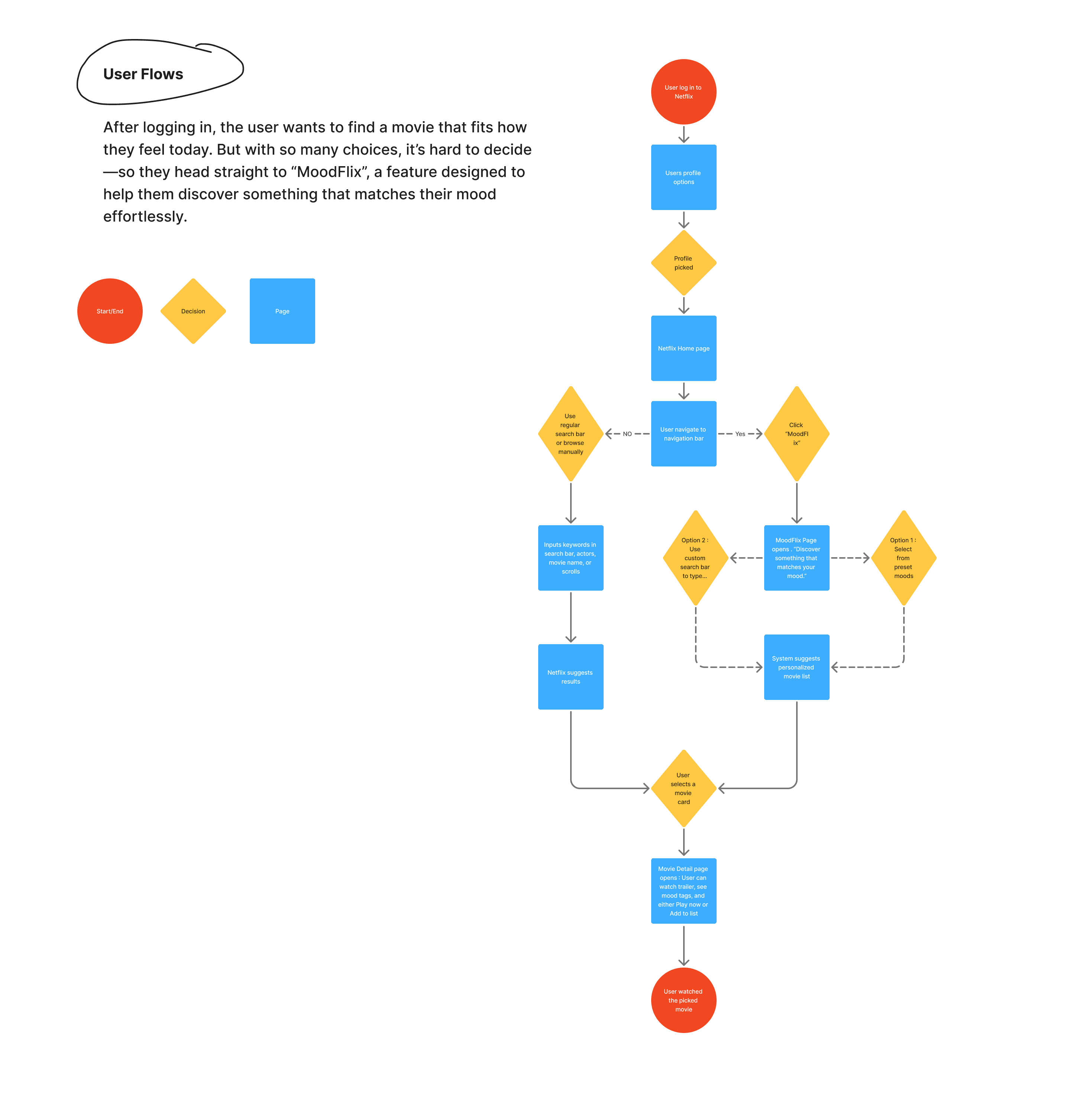
After comparing different approaches, I chose a combination of preset mood cards and an optional custom mood search bar. This balanced speed with flexibility while keeping the interface simple.
To maintain familiarity, I placed MoodFlix directly within Netflix's main navigation instead of creating an entirely separate experience.
Task Completion Rate 5/5 (100%)
All participants successfully completed the task of finding a movie using MoodFlix without assistance.
Navigation & Ease of Use 4/5 (80%)
Four participants immediately understood the MoodFlix flow, while one participant hesitated when deciding between preset moods and custom mood search.
Mood Recommendation Relevance 4/5 (80%)
Four participants felt the recommended movies matched their mood well. One participant wanted more personalized recommendations and additional mood options.
Overall Satisfaction 4.5/5 (90%)
Participants described the experience as easier, more enjoyable, and less overwhelming than traditional browsing. Most said they would use MoodFlix if it were available on Netflix.


